
ANYWAVES: collaborating to enable the next-generation of Reflectarray systems
Reflectarrays moving from theory to orbit
Reflectarray antennas have long been a topic of academic research, but transitioning these concepts into reliable, in-orbit systems introduces a different level of complexity, where manufacturability, robustness, and scalability become just as critical as electromagnetic performance.
This is exactly the challenge addressed through the collaboration between Anywaves and TICRA.
At EuCAP 2026 in Dublin, representatives from Anywaves – Nelson Fonseca and Maxime Romier – and TICRA – Andreas Ericsson Ahlgren – came together to discuss a key milestone: the successful in-orbit deployment of a reflectarray antenna by Anywaves.
Watch the full conversation below:
Enngineering challenges behind reflectarrays
Reflectarrays combine aspects of phased arrays and reflector antennas, relying on carefully engineered surface elements to control phase distribution and shape the radiated beam. While conceptually powerful, their practical implementation introduces several challenges:
-
Large-scale optimisation problems: realistic reflectarray designs can involve thousands of elements, each requiring precise tuning;
-
Complex electromagnetic interactions: mutual coupling and quasi-periodic behavior must be accurately captured;
-
Tight performance constraints: space applications demand high efficiency, low mass, and reliability under harsh conditions;
-
Industrialisation requirements: designs must transition from prototypes to repeatable, manufacturable products
Enabling design with QUPES
|
TICRA’s QUPES software plays a central role in making advanced reflectarray systems feasible. Specifically developed for quasi-periodic structures, QUPES enables:
|
|
|---|
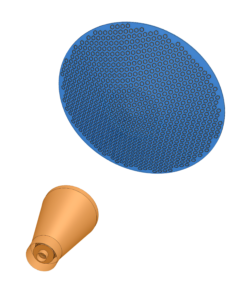
This capability is essential when scaling reflectarray concepts into deployable systems, where computational efficiency directly impacts development timelines and feasibility.
A collaborative approach to innovation
The success of reflectarrays in orbit is not driven by software or hardware alone. It is the combination of:
- Advanced antenna hardware expertise from Anywaves
- State-of-the-art electromagnetic modelling and optimisation tools from TICRA
- Long-term research and validation, including collaboration with the European Space Agency (ESA)
Together, these elements create a pathway from concept to deployment, enabling new antenna architectures for next-generation satellite missions.
👉 Download our Brochure here and navigate through page 7 for specifics on QUPES.
👉 LinkedIn post: click here.