

ARRAY - Phased Array Antenna Design and Simulation Software
Purpose-built software for phased-array antenna design, analysis and optimisation
From element-level to full-wave performance
ARRAY is a complete phased-array software solution for the analysis, synthesis, and full-wave modelling of array antennas. No matter if you use simple or stacked patches, horns, helices or completely different elements, ARRAY provides fast and accurate analysis. With the computational efficiency that characterises all of TICRA´s software. Whether you are an antenna engineer analysing performance from the element level to full-wave installed conditions, or a systems engineer evaluating high-level trade-offs, ARRAY provides all the tools you need in a single integrated environment.
Why ARRAY
- Unified workflow: Stay within one environment from concept to validated design.
- Accuracy where it counts: From approximate methods to full-wave fidelity.
- Built-in beamforming and optimisation: Quickly reach the required performance on element and array level.
- Fast design iteration: Accelerate feasibility studies and tender responses.
- Reduce testing and cost: Predict performance reliably and minimise physical prototyping.
- Scalable performance: Efficiently simulate large arrays with reduced computational resources.
Key product highlights
- Library of predefined elements for fast project setup.
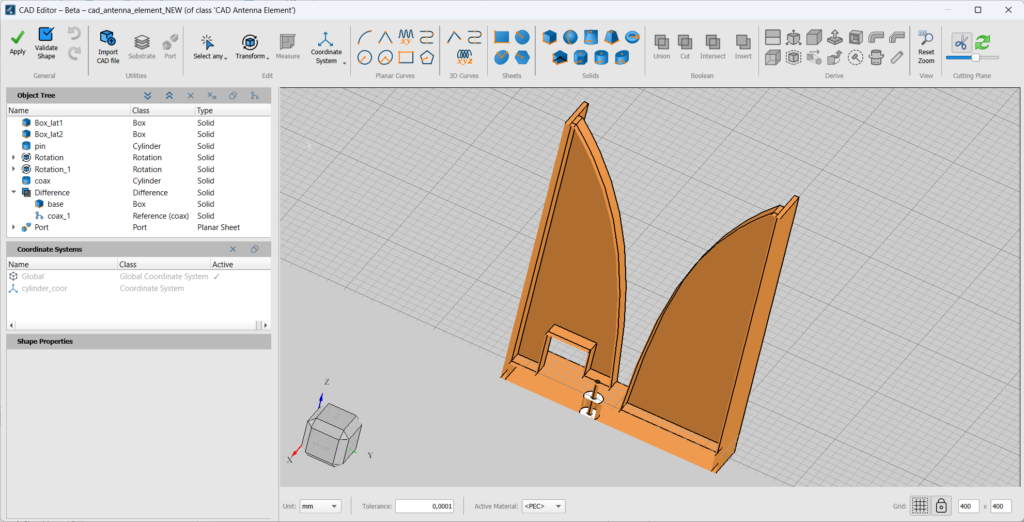
- CAD editor for full flexibility in geometry definition.
- Accelerated solver for patch arrays with multilayered PCBs.
- Combine different elements and layouts freely within one array.
- Array generator with live plot updates and real-time performance feedback for high-level investigations.
- Fast direct solver that analyses large arrays quickly with low memory requirements.
Analyse elements in stand-alone or infinite arrays
Start where array design begins with the element itself. Use built-in templates such as helical or layered patch designs, or Vivaldi designs, and a parameterised CAD editor to handle complex geometries. Analyse elements in stand-alone or infinite-array configurations, including active reflection coefficients and embedded element patterns.
Full-wave analysis of arrays
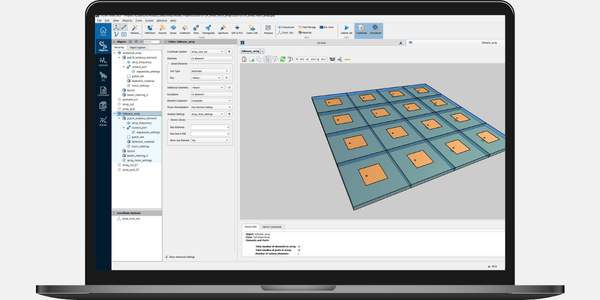
Set up array geometries using predefined or custom layouts. Mix element types within one array, for example patch or multilayered PCB elements used in radar and 6G systems. A highly efficient Fast Direct Solver (FDS) enables short run times and low memory use, even for large arrays.
Array Liveplot for immediate insight
Use Array Liveplot to set up analytical arrays quickly and get instant feedback during synthesis or early trade-offs. Analytical arrays can also be used for beamforming and further analysis.
Explore analytical array capabilities
Advanced geometries and multilayered PCBs
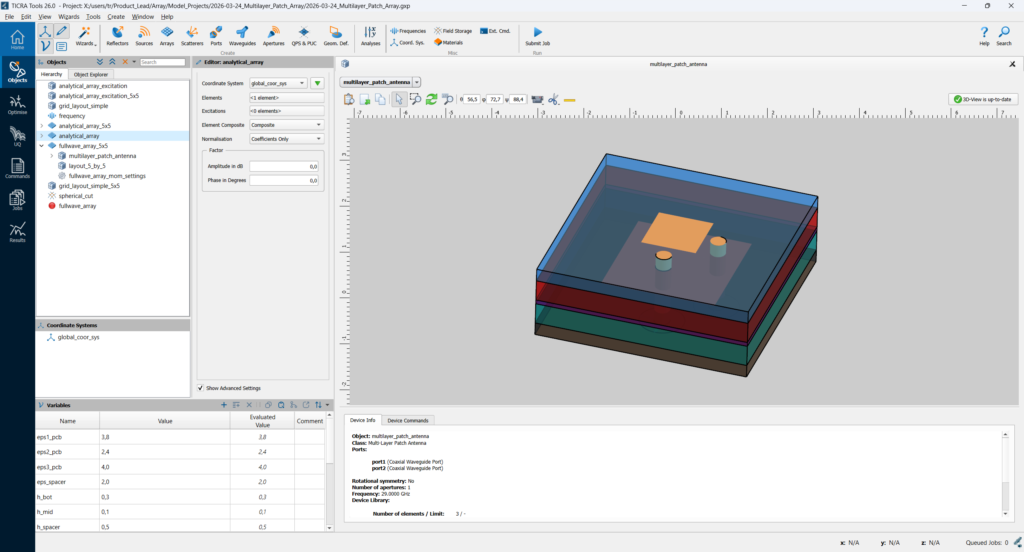
Model multilayer PCB-based elements with a dedicated solver. Extend models with external geometries such as radomes to capture their impact on patterns and S-parameters. This approach is particularly suited for planar AESA radar panels, where multilayer substrates and radomes must be modelled with precision.
Native optimisation
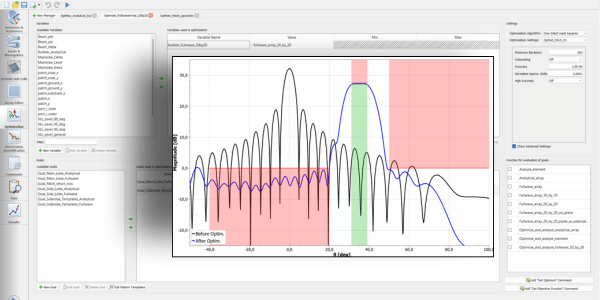
Optimise element and array geometries as well as beamforming coefficients to meet pattern masks or S-parameter constraints, both passive and active. ARRAY supports single- and multibeam systems using phase-only, amplitude-only, or amplitude-and-phase beamforming. It also integrates seamlessly with GRASP for array fed reflectors.
Integrated in TICRA Tools
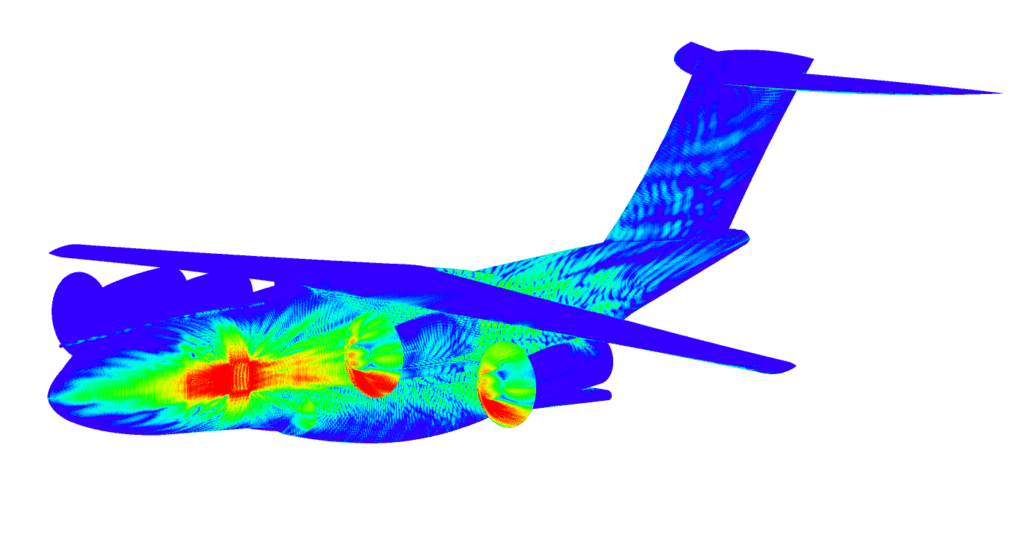
The ARRAY product is fully integrated into the TICRA Tools framework. Combine ARRAY with CHAMP 3D for efficient design of horn arrays, add GRASP for array-fed reflectors, and use ESTEAM to analyse the installed performance of your array.
Radar &
Defence
High-frequency planar and patch-based AESA arrays, beam steering, and radome effects.
Satellite
Communications
Payload arrays, active/passive beamforming, multi-beam coverage, and ground-station subsystems.
Science &
Earth Observation
Novel array architectures, coupled structures, and high-performance radiometers.
FAQs
The commercial release is scheduled for 26 March 2026, but you can request your free trial already now.
Yes, both the full-wave and analytical arrays support mixing any number of different array elements.
ARRAY supports all types of array elements. The built-in CAD editor provides an easy-to-use interface for setting up parameterized geometries of any element geometry – from multilayer patch antennas to helical antennas to waveguide and horn elements.
In ARRAY it is possible to set up any array geometry. The built-in layouts include planar grid layouts in both rectangular, circular, and arbitrary shapes and the possibility for the user to define custom locations and orientations for each element in the array – which is useful for conformal arrays and other arrays where the array has 3D variations.
Yes, the array simulation can include the effect of any number of external geometries, including dielectric radomes and conducting structures around the array.
It is possible to model and optimize multibeam systems. ARRAY includes advanced optimization goals for multibeam arrays, e.g., for limiting the power through the individual elements in the array and reaching specified EIRP values for individual beams. The array can also be optimized for minimum total reflected power in multibeam systems.
Yes, ARRAY includes tools for all stages in the analysis and design of arrays. This includes the Array Liveplot which allows the user to quickly set up and analyze arrays of a number of different built-in antenna elements.
ARRAY and TICRA Tools in general include multithreading as standard. You can use any number of threads on a single computer – including using threads across multiple processors for multi-processor workstations.
Contact us

Uğur Meriç Gür
- Technical Sales Engineer
- +45 3312 4572
- info@ticra.com