
Analyse Complex Platform Scattering and Radar Cross Section Rapidly
Incorporate real-world scattering into your design process and optimise accordingly.
Complex platform geometries push standard EM solvers too far
When you place an antenna on a complex platform, the surrounding structure becomes part of the electromagnetic problem. Mounting platforms and nearby structures introduce scattering effects that isolated analysis cannot capture. Accurately modelling these interactions on electrically large geometries demands solvers that combine full-wave rigour with computational efficiency. Standard tools rarely deliver both.
TICRA has delivered trusted scattering and RCS analysis tools to space, defence and telecommunications programmes for decades.
Our solution to your scattering and RCS challenges
ESTEAM
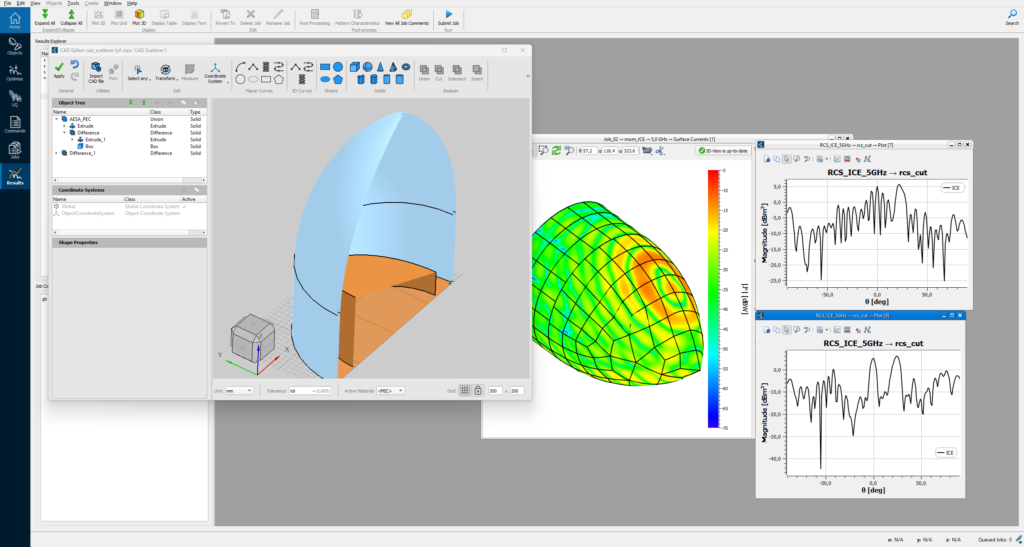
3D scattering and RCS
Solve electrically large scattering and RCS problems using higher-order MoM and MLFMM solvers.
Technical capabilities that drive results
-
Higher-order MoM solver
Analyse scattering and radiation problems on complex geometries with reduced memory consumption and fast runtimes. -
MLFMM acceleration
Scale full-wave analysis to electrically large structures without the computational cost of standard MoM implementations. -
Monostatic RCS computation
Set up and run monostatic RCS calculations directly within the simulation environment for rapid signature assessment. -
Flexible geometry handling
Build parametric objects in the integrated CAD editor or import complex structures in STEP or IGES format. -
Dielectric and conducting surfaces
Assign a wide range of surface material properties, from perfect conductors to dielectric coatings, across any geometry. -
CAD-native meshing
Apply adaptive meshing directly to imported and parametric geometries for accurate discretisation without manual intervention.
Industries relying on scattering and RCS analysis

Space
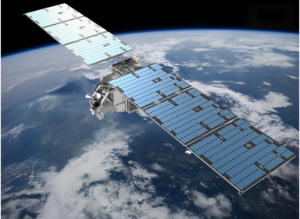
Satellite platforms carry multiple antennas surrounded by complex structures. Accurate scattering analysis ensures platform interactions are accounted for before launch.
Defence
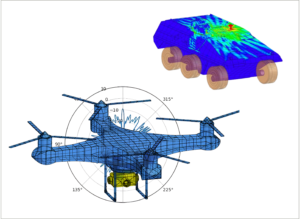
Wideband radar systems, stealth platforms and low-RCS apertures rely on periodic and quasi-periodic surfaces. These designs deliver mission-critical performance and advanced capability across defence applications.
Telecommunications
Reflectarray and transmitarray antennas based on quasi-periodic designs are expanding 5G and 6G infrastructure, enabling high-frequency, high-capacity wireless connections globally.

Automotive
Radar sensors integrated into vehicle bodywork operate in a scattering-rich environment. Accurate modelling of coupling and platform effects is essential for reliable system performance.
See what TICRA's scattering tools can do for you
Get hands-on through a free trial. If you’d prefer to discuss your platform scattering challenges first, our engineers are ready to help.
Some frequently asked questions
Full-wave analysis of electrically large structures is computationally demanding. TICRA's implementation of higher-order MoM and MLFMM acceleration makes it practical to analyse platform-scale geometries at the frequencies relevant to space, defence, and automotive applications. Without the memory and runtime penalties of standard MoM approaches.
Yes. Complex structures can be imported directly in STEP or IGES format. Parametric geometry construction is also available for structures defined within the simulation environment.
Adaptive meshing is applied automatically, so you are not manually discretising imported models.
Scattering analysis complements your antenna design workflow rather than replacing it.
You bring your antenna model into the platform environment, run scattering and coupling analysis, and feed results back into your design process. The earlier you do this, the more freedom you have to act on what you find.
TICRA tools have been validated against measured data across space, defence and research programmes over decades. Correlation studies consistently show close agreement between predicted and measured RCS and radiation patterns on complex platform geometries
Surface property variations and geometric tolerances can be incorporated into scattering models to assess their impact on RCS and antenna performance.
Running parametric studies across a tolerance range gives you a realistic picture of expected in-service performance rather than a single idealised result.
As early as possible. Platform scattering effects discovered during integration testing leave little room to redesign.
Introducing scattering analysis alongside antenna design lets you iterate on both before design commitments are made, reducing risk and late-stage rework.
Yes. Satellite platform interactions, automotive radar integration, and base station antenna placement all involve scattering problems that affect system performance.
RCS and platform scattering analysis is not exclusive to low-observable design. It applies wherever the surrounding structure influences how your antenna performs.