
From simulation to orbit: supporting Europe’s next generation of weather satellites
Weather forecasting depends on understanding the atmosphere with extraordinary precision. Every day, satellite-borne microwave sounding instruments measure temperature and humidity across the globe, providing data that feeds the numerical weather prediction models used by meteorological organisations worldwide. Even small measurement errors can influence forecast quality.
When the Arctic Weather Satellite (AWS) project from the European Space Agency (ESA) set out to demonstrate a new generation of compact microwave radiometers, the challenge was therefore about much more than building a smaller satellite. It was about understanding exactly how the instrument would behave before it ever left Earth.
Working with researchers at the University of Bern, TICRA supported an extensive electromagnetic simulation campaign that helped engineers understand the behaviour of the complete instrument. The resulting models are now incorporated into the operational processing of the Arctic Weather Satellite and are helping shape future European weather satellite missions.
 – Arctic Weather Satellite (ESA) |
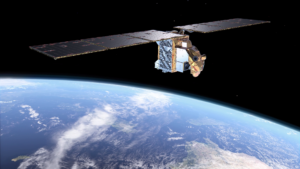 – Weighing just 125 kg and measuring 1.0 m x 5.3 m x 0.9 m, ESA’s Arctic Weather Satellite is a small satellite, but with big ambitions (ESA) |
Project at a Glance
Topic |
Details |
Mission |
Arctic Weather Satellite (AWS) |
Organisation |
OHB Sweden (Prime Contractor)
AAC Omnisys (Instrument prime)
Roland Albers (MMOSS & Institute of Applied Physics, University of Bern)
|
TICRA Software |
GRASP and ESTEAM |
Challenge |
Understanding and compensating for spillover and platform scattering in a compact microwave radiometer |
Outcome |
Simulation models incorporated into the operational processing chain and supporting future constellation development |
A smaller satellite with bigger challengesThe ambition behind AWS was clear: demonstrate that a much smaller satellite could deliver the quality of measurements required for operational weather forecasting. However, reducing the size of the instrument fundamentally changed the electromagnetic problem, as no beam alignment optics could be used. Interactions with the surrounding spacecraft became more significant, while multiple operating frequencies and scan angles added further complexity. Effects that had previously been of little importance suddenly became design-critical. Understanding these interactions through measurement alone would have been extremely difficult. |
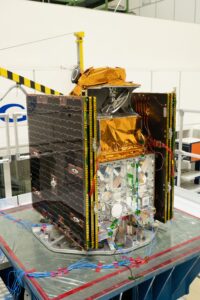 – ESA’s Arctic Weather Satellite being prepared for environmental tests at IAGB in Ottobrunn, Germany (ESA) |
Why simulation became the better investment
Rather than relying solely on hardware development, the team chose to invest heavily in simulation. Roland Albers explains that this approach made particular sense because the long-term vision extended beyond a single satellite. To ensure the success of deploying a potential constellation of weather satellites, every design improvement would be replicated many times over. Hundreds of simulations were therefore performed to reduce uncertainty before hardware was finalised.
When GRASP wasn’t enough
The work initially started in GRASP, where the antenna itself could be analysed in detail using rapid and accurate Physical Optics (PO). As the project progressed, it became clear that understanding the antenna alone was insufficient. Engineers also needed to model how the surrounding spacecraft influenced the overall optical performance of the antenna.
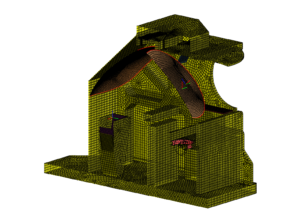 – A slice through the 3D mesh model of the AWS optics in ESTEAM |
This led the team to ESTEAM, which enabled including the full instrument structure and its scattering in the simulation. Some of the highest-frequency models required weeks of preparation and hyper-accurate degrees of computation, pushing both the modelling techniques and software capabilities to new levels.
Through this analysis, additional safeguards against stray scattering such as a baffle and absorbing sheets were incorporated into the model and the eventual antenna. |
A collaboration beyond software
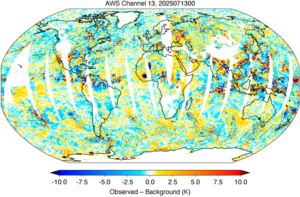 – Arctic Weather Satellite reveals ice clouds (ESA) |
The project evolved into a close engineering collaboration between the Roland Albers (Former PhD student at the University of Bern) and TICRA.
TICRA engineers, including Mustafa Murat Bilgic and Mark Whale, supported the development of complex simulation models and helped solve demanding technical challenges throughout the programme.
|
Roland highlights the value of this collaboration not simply because questions were answered quickly, but because discussions were conducted at an advanced level with deep understanding of the issues at hand. Based on his experience, he encourages his colleagues in the group to contact TICRA directly when they encounter challenging modelling problems.
“Without these simulations, we would not be able to accurately calibrate the instrument.”
— Roland Albers (MMoss)
From research to operational weather forecasting
One of the most remarkable outcomes of the project is that the work did not end with a publication. The simulation models developed during the programme became part of the operational processing chain for the AWS itself. This means the engineering work now contributes directly to the interpretation of measurement data collected in orbit, improving the quality of the information used for weather forecasting.
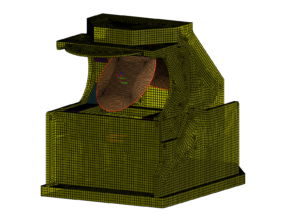 – The MoM Mesh of the AWS optics and frame, including absorbers and calibration target |
 – The animated currents on the AWS revealing the extraneous scattering |
Technical sidebar
Spillover occurs when part of the antenna pattern extends beyond the reflector, allowing unwanted radiation to enter the receiver. Platform scattering occurs when electromagnetic waves reflect from nearby spacecraft structures before reaching the antenna. For highly sensitive weather instruments, both effects can influence measurement accuracy. Electromagnetic simulation allows these effects to be quantified before launch, when design changes are still possible.
“I encourage my colleagues to contact TICRA because you get fast, detailed and genuinely useful technical answers.”
— Roland Albers (MMOSS)
Why this matters
- Simulation results are used operationally rather than remaining purely academic.
- Reduced engineering uncertainty before launch.
- Demonstrates the value of modelling the complete spacecraft environment.
- Supports future European weather satellite programmes.
- Shows how close collaboration between software developers and engineers can improve mission performance.
Looking ahead
Building on the success of AWS, the collaboration continues through new ESA activities focused on the next generation of microwave sounding instruments.
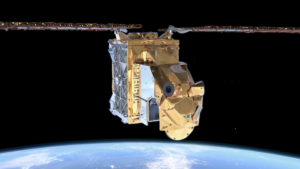 – Arctic Weather Satellite close up (ESA) |
For TICRA, the project illustrates that advanced electromagnetic simulation is not simply about analysing antennas – it is about giving engineers the confidence to make critical design decisions before hardware is built.
For For weather satellite operators, it demonstrates how simulation can become an integral part of operational space missions. |
Follow the link to the papers below to read more about this project:
 Method of Moment simulation of full Arctic Weather Satellite structure – TICRA
Dr. Roland Albers continues with his work and research within remote sensing applications via his engineering consultancy firm MMOSS.

Mustafa Murat BilgicSenior Research Engineer |

Mark WhaleSenior Research Engineer |