
Our engineering services
-
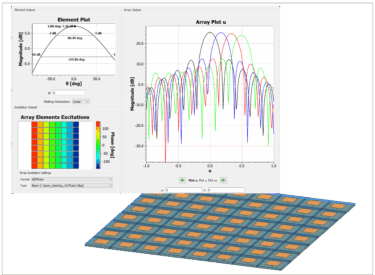
Feasibility studies and initial trade-offs
We carry out early-stage studies to explore antenna concepts, identify performance boundaries, and evaluate key technical trade-offs. Using TICRA’s trusted EM solvers, we provide fast, reliable predictions to guide architecture selection and reduce design risk. -
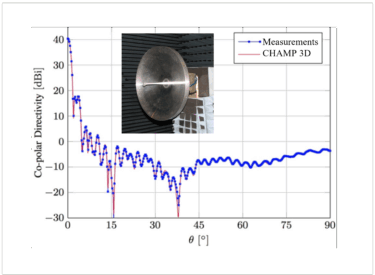
Preliminary and detailed antenna design and analysis
We design and analyse antennas across a wide range of applications—from reflector systems and feeds to planar and array-based solutions. Our team delivers high-fidelity modelling, optimisation, and performance evaluation to ensure robust results throughout the design cycle. -
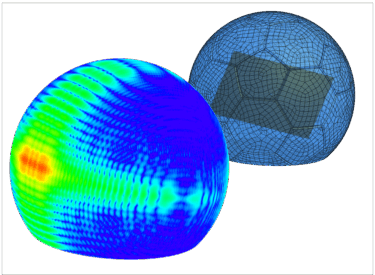
RF and electromagnetic modelling
We build detailed EM models to investigate radiation characteristics, losses, coupling, and platform interactions. Using full-wave and asymptotic techniques, we provide insight into system behaviour and support design optimisation, verification, and correlation with measurements. -
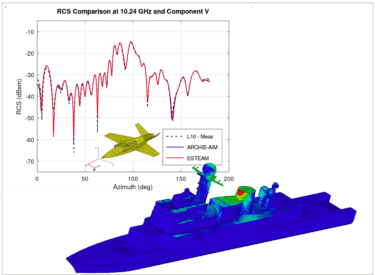
Platform scattering, antenna placement, and radar cross section
We analyse how antennas interact with surrounding structures and assess the impact of scattering, blockage, and RCS. Our modelling ensures correct placement, minimal interference, and predictable performance in the final platform environment - whether in space, defence, or communication systems. -
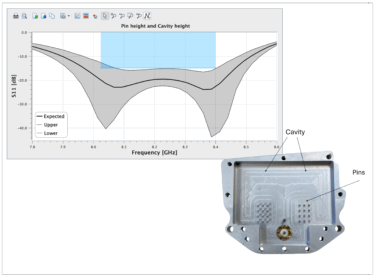
Uncertainty qualification analysis
We evaluate how manufacturing tolerances, material variations, and environmental factors influence final antenna performance. This analysis supports margin allocation, risk reduction, and confidence during qualification and acceptance testing. -

Software training, workshops, and knowledge sharing
We offer tailored training sessions to help users apply TICRA Tools efficiently and accurately. Our workshops combine theory, modelling strategies, and hands-on exercises to strengthen in-house EM capability and accelerate project outcomes.


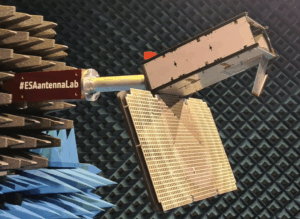
Design and RF Testing of Reflectarray for Cubesat at X-band
Design, manufacturing and test of a compact and deployable, circularly polarized X band reflectarray antenna for a 6U CubeSat. The resulting design consists of a cavity feed that protrudes less than 4 mm into the CubeSat. The reflectarray has a deployed area of 30 × 60 cm², realized using three panels, each measuring 30 cm × 20 cm, and stowed in less than 10 mm between the 6U CubeSat rails and the launch pod. The feed is linearly polarised and the reflectarray converts the polarization from linear to circular.
The final antenna system achieves a gain exceeding 29 dB, as confirmed by simulations and measurements.
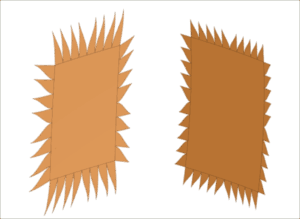
Detailed Electrical Design of a Novel High Performance Compensated Compact Antenna Test Range
Detailed electrical design of a dual compensated compact antenna test range (CATR). The CATR meets the stringent requirement of an overall peak-to-peak amplitude ripple of 0.5 dB and phase ripple of 4 deg, from 1 GHz to 400 GHz. We used a novel design approach making use of an initial trade-off with ray tracing and a subsequent detailed full wave analysis and optimization at 1 GHz of the serrations profile, length and orientation.
Read about the choices taken during the design and see the detailed performances.
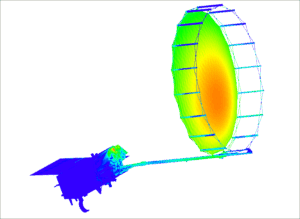
Platform Scattering Analysis of the Copernicus Imaging Microwave Radiometer
Platform scattering analysis of the Copernicus Microwave Imaging Radiometer (CIMR). The radiometer employs a 7.1 m conical scanning mesh reflector antenna rotating at 7.8 rpm and operating from L to Ka band. The demanding radiometric accuracies and sensitivities of the instrument require high accuracy in the modelling of the antenna pattern considering any nearby scattering structure and/or any potential multipath due to the antenna installation over the spacecraft. A detailed platform scattering analysis of the reflector antenna on the CIMR satellite was thus undertaken for a subset of feeds at all bands.
Read about the effect of the scatters over the antenna RF performances.
Contact our application expert